The Naturmuseum Senckenberg (SMF) is a museum of natural history, located in Frankfurt am Main. It is the second-largest of its kind in Germany. In 2010, almost 517,000 people visited the museum, which is owned by the Senckenberg Nature Research Society. Senckenberg's slogan is "world of biodiversity". As of 2019, the museum exhibits 18 reconstructed dinosaurs.
History
In 1763, Johann Christian Senckenberg donated 95,000 guilders–his entire fortune–to establish a community hospital and promote scientific projects. Senckenberg died in 1772. In 1817, 32 Frankfurt citizens founded the non-profit Senckenberg Nature Research Society, German: Senckenberg Gesellschaft für Naturforschung (SGN), which is a member of the Leibniz Association. Soon after, Johann Georg Neuburg donated his collection of bird and mammal specimens to the society. The Naturmuseum Senckenberg was founded in 1821, just four years later. Initially located near the Eschenheimer Turm, the museum moved to a new building on Senckenberganlage in 1907. In 1896 a mummified Egyptian child in their collection (inventory number ÄS 18) was the subject of the first mummy X-ray. During World War II, the building was partly destroyed. However, the exhibits had been evacuated before.
Building
The neo-baroque building housing the Senckenberg Museum was erected between 1904 and 1907 by Ludwig Neher outside of the center of Frankfurt in the same area as the Johann Wolfgang Goethe University, which was founded in 1914. The museum is owned and operated by the Senckenberg Nature Research Society. The exhibition area covers 6,000 m2 (65,000 sq ft).
Source:
Expansion plans
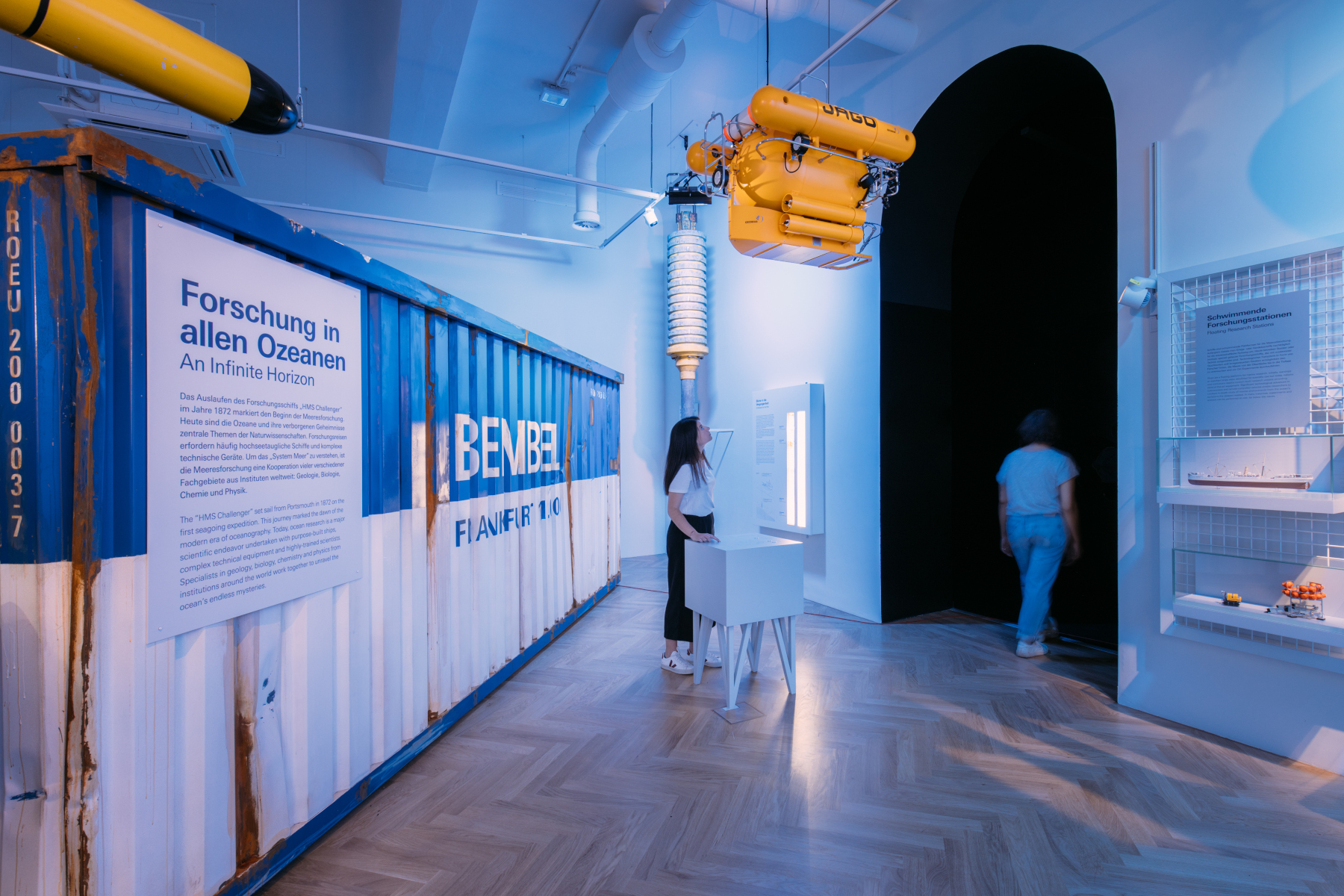
As of 2018, the museum has been expanded to 10,000 m2 (110,000 sq ft). New planned sections: Human, Earth, Cosmos, Future.
Directors
- 2021–2024 Brigitte Franzen
- 2021–present Klement Tockner, General director, Senckenberg Nature Research Society
Collections
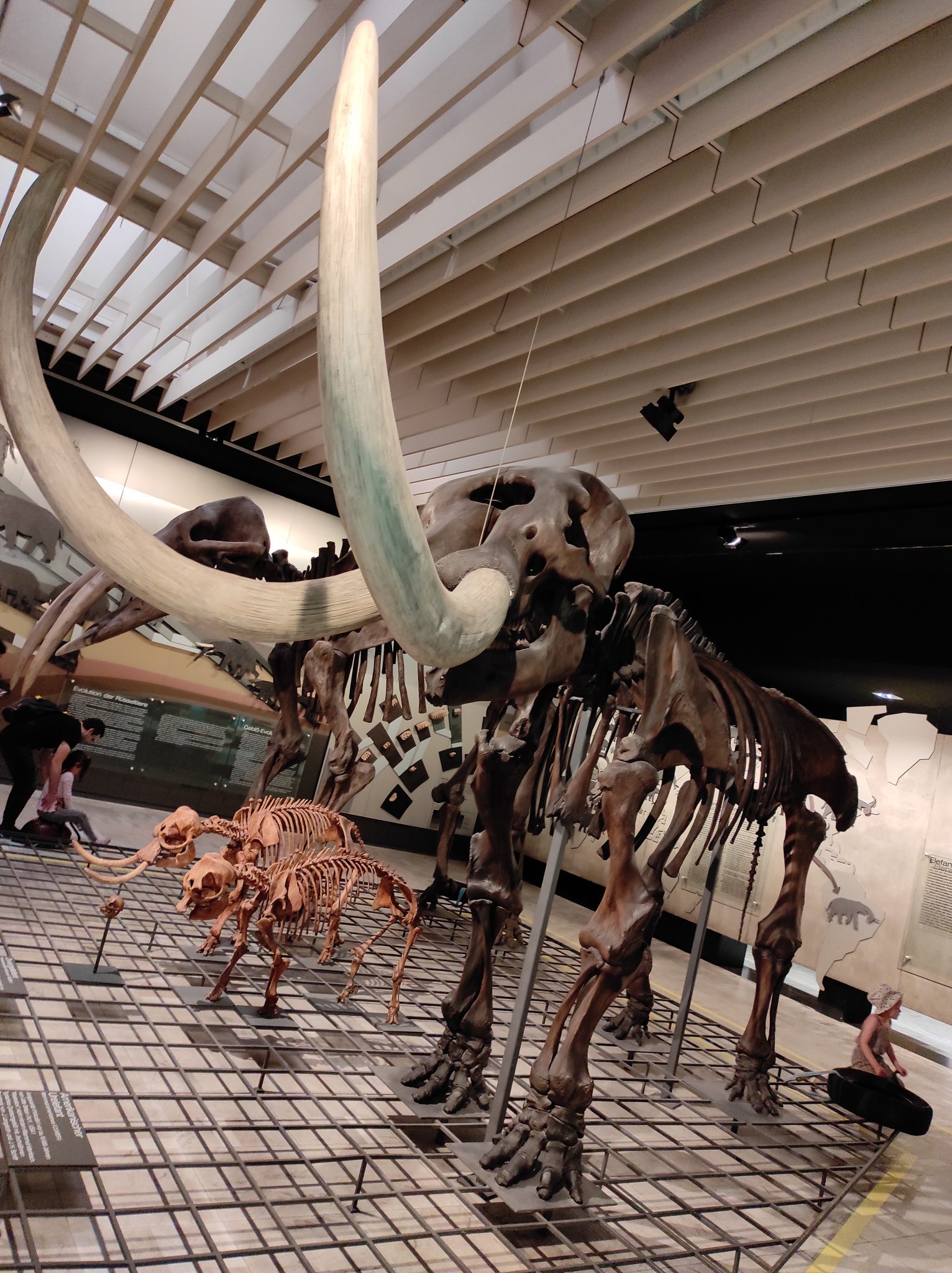
The Senckenberg Museum Frankfurt has a large collection of animal, plant and geology exhibits from every epoch of Earth's history.
Dinosaurs
Diplodocus
Main attraction is a Diplodocus from Bone Cabin Quarry, Wyoming, donated by the American Museum of Natural History on the occasion of the present museum building's inauguration on 13 October 1907, The 18 m (59 ft) mounted skeleton with additions contains bones of three different sauropod genera (Diplodocus and closely related Apatosaurus and Barosaurus).
Psittacosaurus
As of 2022, a key holding is a fossilized Psittacosaurus (specimen SMF R 4970) from Liaoning, China, with clear bristles around its tail and visible fossilized stomach contents. The specimen was first reported in 2002. The exact date and locality of the discovery within Liaoning is unknown. A controversial debate about the legal ownership arose. In 2021, researchers described its cloaca in more detail and found similarities with the body outlet of birds. In 2022, for the first time a belly button was found in a dinosaur fossil. A physical life reconstruction of the animal was prepared by paleoartist Robert Nicholls.
Edmontosaurus and Triceratops
Another originals are an Edmontosaurus annectens mummy (specimen SMF R 4036) from Lance Formation, Wyoming. and two Triceratops skulls. The museum bought the three specimen from fossil collector Charles Hazelius Sternberg and his sons in the early 20th century. The museum also exhibits a cast of a complete Triceratops, the museum's mascot.
Casts
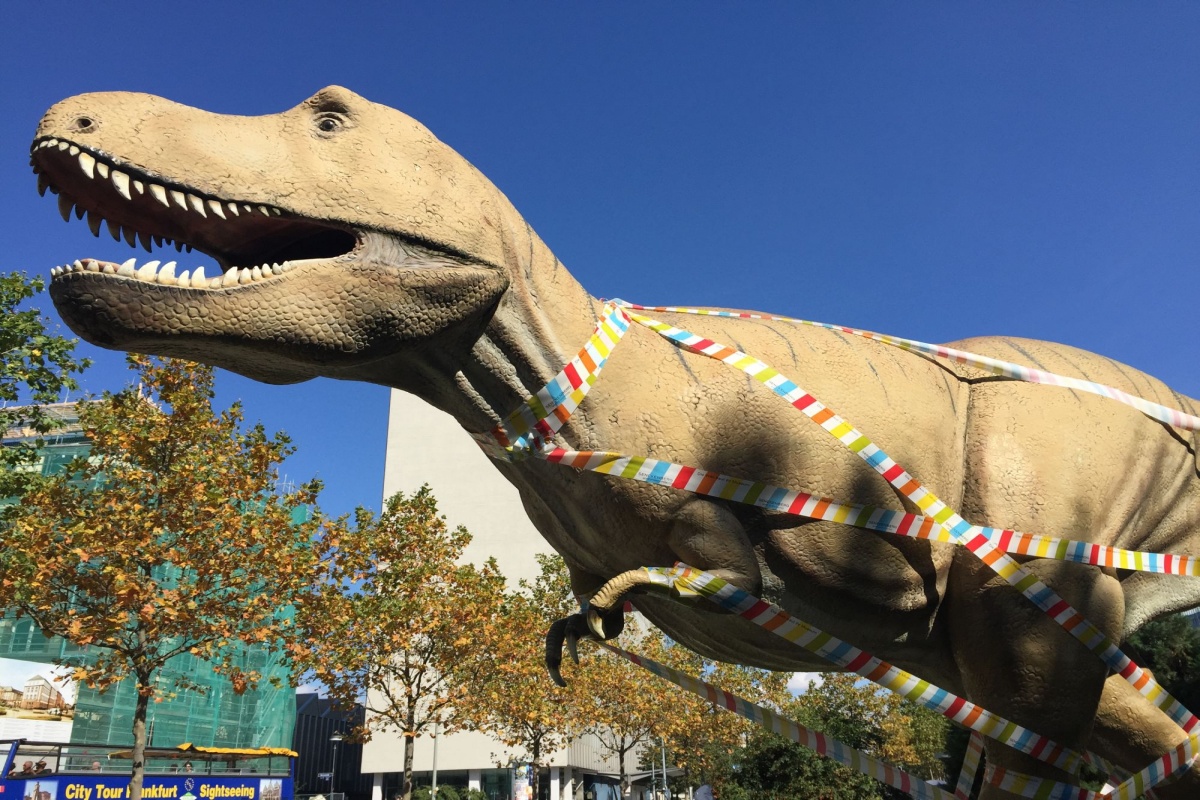
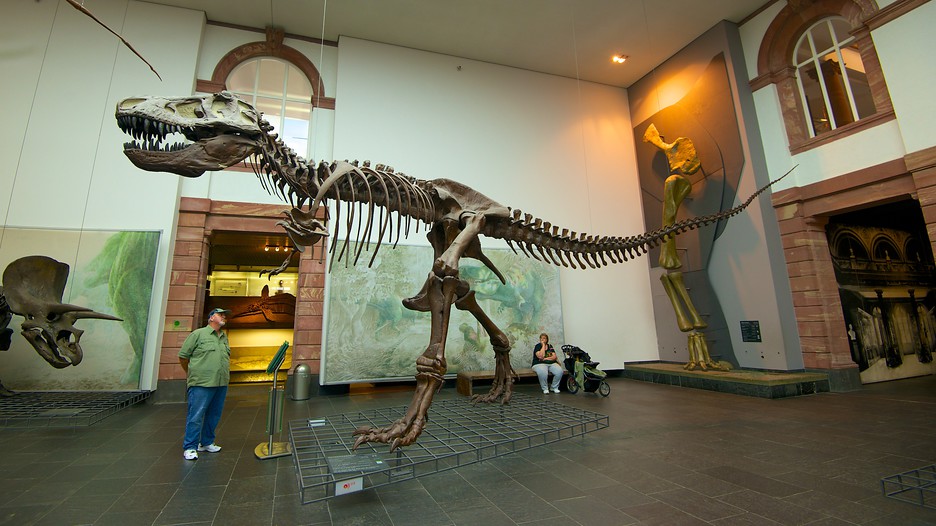
Big public attractions also include the casts of Tyrannosaurus rex and Diplodocus longus (in front of the museum), an Iguanodon, the crested Hadrosaur Parasaurolophus and an Oviraptor.
Further casts or single bones:
Birds
A living reconstruction of the extinct dodo and many other stuffed birds are shown in a permanent exhibition in the upper level. Additionally, the museum owns a large and diverse collection of birds with 90,000 bird skins, 5,050 egg sets, 17,000 skeletons, and 3,375 spirit specimens (a specimen preserved in fluid). This is 75% of the known bird species, only a minor part is exhibited.
Reptiles
Anaconda is one of the oldest and most popular exhibits. Since the remodeling finished in 2003, a new reptile exhibit addresses both the biodiversity of reptiles and amphibians and the topic of nature conservation.
Messel research
The museum houses many originals from the nearby Messel pit, Germany's first UNESCO World Natural Heritage Site, among them a predecessor to the modern horse that lived about 50 million years ago and stood less than 60 cm (24 in) tall. In 2015, researchers found an foal fetus in the body of the petrified primeval horse mare. Also primates, crocodiles, bats, snakes, turtles and other fossils were found at Messel pit.
Mammals
Display collections full of stuffed animals are arranged in the upper levels; among other things one can see one of twenty existing examples of the quagga, which has been extinct since 1883.
The mammal collection focuses on bats, primates, rodents, and insectivores (not exhibited).
Human evolution
Unique in Europe is a cast of the famous Lucy, an almost complete skeleton of the upright, 1 m (3 ft 3 in) tall, hominid Australopithecus afarensis. The exhibition also includes reconstructions of the heads of human ancestors.
Gallery
See also
- Museumsufer
- Edmontosaurus mummy SMF R 4036
- Messel pit
- Museum of Natural History, Görlitz
Notes
References
Further reading
- Natur-Museum und Forschungs-Institut Senckenberg (1972). Senckenberg Natural History Museum of the Senckenberg Natural History Research Society : [guide-book]. Frankfurt am Main: Kramer. ISBN 978-3-7829-1039-2. OCLC 1256488478.
- Ziegler, Willi (1987). Naturmuseum Senckenberg Führer durch d. Ausstellungen (in German). Frankfurt am Main: Kramer. ISBN 978-3-7829-1108-5. OCLC 74831798.
- Senckenberg. Naturforschende Ges., Frankfurt a. Main (1972). Natur-Museum Senckenberg (in German). Frankfurt (am Main): Kramer. ISBN 978-3-7829-1040-8. OCLC 74134133.
- Stillbauer, Thomas (29 April 2021). "Frankfurt: Senckenberg wächst enorm". Frankfurter Rundschau (in German). Retrieved 30 December 2022.
- "Das neue Senckenberg: Mehr Platz für die großen Fragen". Süddeutsche.de (in German). 29 April 2021. Retrieved 30 December 2022.
- "150 Jahre Senckenbergische Naturforschende Gesellschaft in Frankfurt, 28. Oktober 1967". Zeitgeschichte in Hessen (in German). Retrieved 30 December 2022.
- Scholz, Joachim; Afshar, Karin (2017). Briefe an die Lebenden Geschichten aus dem Senckenberg-Museum (in German). Frankfurt am Main: Senckenberg Gesellschaft für Naturforschung. ISBN 978-3-929907-93-3. OCLC 986511315.
- Baumann, Margret; Bauer, Friederike; Senckenberg Gesellschaft für Naturforschung (2020). 200 Jahre Senckenberg. Die Zeit von 1993–2017 (in German). Stuttgart: E. Schweizerbart'sche Verlagsbuchhandlung, Nägele und Obermiller. ISBN 978-3-510-61416-5. OCLC 1192503441.
- Kühl, Stefan; Müller, Vera; Wolff, Birgitta. "Museum für Dodo, Dinos und Menschheits-Fragen". Forschung & Lehre (in German). Retrieved 30 December 2022.
- "Vor 200 Jahren gegründet: Die Senckenbergische Naturforschende Gesellschaft – Mit Bürgersinn der Natur auf der Spur". Deutschlandfunk (in German). 22 November 2017. Retrieved 30 December 2022.
- Mosbrugger, Volker; Dürr, Sören; Havlik, Philipe; Herkner, Bernd; Moll, Valentina; Neitscher, Eva; Rossmanith, Eva, eds. (2015). Auge in Auge mit der Natur Senckenberg Naturmuseum Frankfurt (in German). Frankfurt am Main: Senckenberg Gesellschaft für Naturforschung. ISBN 978-3-929907-90-2. OCLC 926153922.
- Nigge, Klaus; Schulze-Hagen, Karl; Fiebig, Jürgen; Vogel, Johannes (2022). Vogelwelten : Expeditionen ins Museum (in German). München: Knesebeck GmbH et Co. Verlag KG. ISBN 978-3-95728-410-5. OCLC 1350778543.
- Patalong, Frank (5 February 2020). "So wird ein Dino zusammengesetzt". Der Spiegel (in German). Retrieved 30 December 2022.
- "Blick hinter die Kulissen der Messel-Forschung". Der Spiegel (in German). 30 September 2012. Retrieved 30 December 2022.
- Seidler, Christoph (1 June 2020). "Neue Ausstellung: Paläontologen graben in Frankfurt nach Dinos". Der Spiegel (in German). Retrieved 30 December 2022.
- "Diplodocus, Clipping from The Morning Post". Newspapers.com. 18 May 1908. Retrieved 3 January 2023.
External links
- Official website (in German and English)
- "Senckenberg Naturmuseum". Museumsufer Frankfurt. Retrieved 21 December 2022.
- "Senckenberg Nature Museum Frankfurt, Frankfurt am Main, Germany". Google Arts & Culture. Retrieved 31 December 2022.
- Das neue Senckenberg-Museum erklärt on YouTube (in German)
- Naturmuseum Senckenberg's channel on YouTube