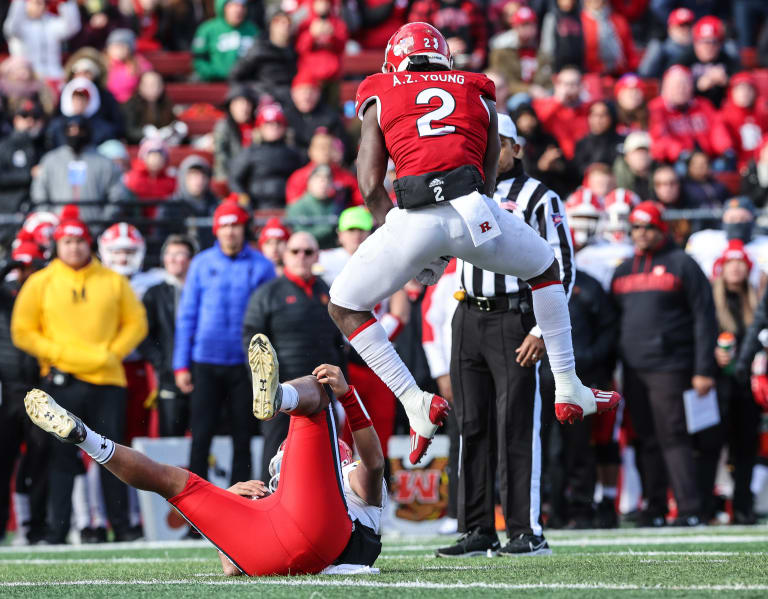
The Maryland–Rutgers football rivalry is an American college football rivalry between the Maryland Terrapins and Rutgers Scarlet Knights.
History
The schools played nine nonconference games between 1920 and 2009, with Maryland holding a 5–4 record... When Maryland and Rutgers joined the Big Ten Conference together in 2014, they were placed in the conference's newly formed East Division.
Through 2024, Maryland leads the series 12–8, with a 7–4 record in conference play. In seven of their first ten Big Ten seasons (2014–23), Maryland and Rutgers were scheduled to play each other in the final week of the regular season.
In 2024, the expanded 18-team Big Ten eliminated divisions but designated Maryland–Rutgers as one of 12 protected annual matchups in the new Flex Protect XVIII model, ensuring the teams would continue to meet annually through at least 2028.
While neither program has achieved competitive dominance in the Big Ten, both schools saw significant financial benefits from Big Ten revenue sharing, with annual athletic department revenues increasing—though they both remain the lowest in the Big Ten. In 2024, Rutgers' athletic revenue was more than $110 million, the 42nd-highest in the NCAA, and one spot ahead of No. 43 Maryland, which brought in $107 million.
Attempted 'Battle in the Bronx'
In 2017, Rutgers attempted to move their home game against Maryland to Yankee Stadium as part of a football and wrestling doubleheader. Marketed as "The Battle in the Bronx," the game was scheduled for November 4, but had to be moved back to their home field at High Point Solutions Stadium (now SHI Stadium) with just two weeks' notice due to the possibility of the New York Yankees hosting World Series games
The Yankees were eliminated from the 2017 American League Championship Series by the Houston Astros one day after Rutgers announced the venue change, meaning the stadium would have been available after all. Rutgers had paid a $750,000 stadium rental fee, which was refunded when the game was relocated. Fan response to the original Yankee Stadium plan had been lukewarm, with many expressing concerns about parking, tailgating, and sight lines, along with the fact that the tickets were a required component of 2017 season ticket packages
Trophy Attempts
In July 2016, Rutgers Athletic Director Patrick E. Hobbs and then-head coach Chris Ash publicly acknowledged having "initial conversations with Maryland" about creating a rivalry trophy. Maryland's response was notably tepid, with head coach DJ Durkin offering what media described as "a bit of a non-answer" at that year's Big Ten Media Days, saying such matters were "more for fans, people around the game."
The trophy discussions generated various suggestions from fans and media, including "The Market Capturer Cup" (referencing both schools' media market-driven addition to the Big Ten), "The Old Oaken Metro Area" (noting neither school's location in their claimed New York and Washington media markets), and "The Iron Traincar Full of Bros Arguing About Moe's and Chipotle" In a November 2014 NJ.com reader poll about potential trophy concepts, the most popular response was "Wait. When did Maryland-Rutgers become a rivalry?" receiving 24.74% of votes, while the top-earning concrete trophy was "Delaware!"
Delaware as a trophy
Initial fan trophy discussions centered on Delaware as a rivalry prize, given the state's location as a narrow buffer between Maryland and New Jersey. While the proposal would be constitutionally impossible given Delaware's status as a sovereign state within the federal system, the suggestion carried surprising historical weight due to both states' historical claims to Delaware's territory dating back to the Penn–Calvert boundary dispute.
Historical Territorial Connection
Maryland's historical connection stems from Cecil Calvert's 1632 charter, which originally included all of present-day Delaware. The lengthy colonial dispute over Delaware's territory was ultimately resolved through the Mason–Dixon line survey.
In 1681, King Charles II granted William Penn a deed to the Twelve-Mile Circle around New Castle, Delaware. Since then, the border between Delaware and New Jersey has been the low-water mark on the eastern side of the Delaware River. New Jersey has long sought jurisdiction over the eastern half of the bed of the Delaware River, raising the matter several times to the U.S. Supreme Court—most recently in New Jersey v. Delaware (2008), which affirmed Delaware's jurisdiction.
Fan Culture
The rivalry is notable for its distinct lack of traditional rivalry elements, with fan interactions characterized primarily by mutual nihilistic acknowledgment of the matchup's arbitrary nature. Despite significant enrollment of New Jersey students at Maryland, the annual meeting generates little genuine animosity between the fanbases. Instead, both schools' supporters tend to approach the conference-mandated matchup with a shared understanding of its pragmatic origins, often expressing this through good-natured resignation rather than traditional rivalry enthusiasm, reflecting both programs' general status within the Big Ten hierarchy.
Media Coverage
Regional media has often focused on the matchup's role within conference realignment strategies. In 2015, On the Banks argued that both programs were "fledglings in the Big Ten, sitting at the kids table in terms of Big Ten rivalries, while the elders, Ohio State, Penn State, Michigan, Michigan State, etc., have had more time to develop true rivalries amongst themselves."
By 2024, national coverage regularly cited the matchup as an example of how conference realignment forced manufactured rivalries, with The Athletic noting that while traditional Big Ten rivalry games "surpass 100 games played and several debuted in the 1890s," newer protected matchups struggled to generate similar gravitas but are driven by geographic convenience.
Game results
See also
- Maryland Terrapins football
- Rutgers Scarlet Knights football
- List of NCAA college football rivalry games
References


/cdn.vox-cdn.com/uploads/chorus_image/image/65408583/_DSC9375.0.jpg)